
Story by Matson Breakey, Photos provided by MetalCloak
The call comes in daily, and I love it.
“I just bought my Jeep, and I don’t know what I should do first.” Awesome.
Even in the world of off-roading, it is rare for us to admit when we don’t know something or to take the time to ask for help. We browse the web, watch some videos, and go for it.
Then, three months later, we realize we did it wrong.
Yeah, we’ve all been there.
Building your ultimate dream rig really just comes down to two basic questions: “What’s Its Purpose?” and “What’s Your Budget?”
Let’s dive in.
Form Over Function
The most basic question you must ask yourself is why. Why do you have a 4×4? What’s its purpose? Where are you going to take this dream rig of yours? Are you planning to run the Rubicon one day? Is Moab your dream destination? Planning to run the Alaskan Tundra? Or do you just want a rig to take your family out on camping trips and fire roads?
No single answer is the right one, and every answer can provide a different build plan.
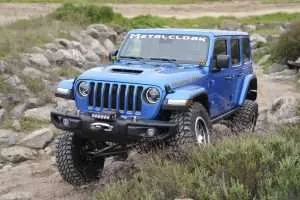
For instance, if you are building a rig for camping, then you might choose a lower lift, keep your stock wheels, only go slightly bigger in tires, and not worry about skid plates or an aftermarket tire carrier and winch.
But if you are planning on crawling the Rubicon next year, you will want a larger lift to run aftermarket beadlocks and bigger tires, definitely get skid plates, aftermarket bumpers, winch, and a tire carrier that can handle the bigger meats.
At Metalcloak, we are constantly working with new Jeep owners to help them understand the difference between form and function.
The most classic example is the 6Pak Shock… truly a unique feat of engineering, the 6Pak has a really cool and unique look, unlike any other dampener on the market. We regularly talk customers out of the 6Paks in favor of a more basic dampener… why? Simply because the 6Pak is a purpose-built shock, and most Jeep owners simply will not ever experience that purpose.
While many 4×4 owners build their rigs for what looks best, it’s best to think function first.
So, let’s go through the functions to consider…
Which Came First, the Lift or the Tires?

The purpose of a suspension and lift kit is simple: you put on a lift kit to allow for bigger tires. You put on bigger tires to move the axle up and out of harm’s way.
The bigger the lift, the bigger the potential tires.
So, how big a suspension do you need? You can approach this question two ways…
Thought exercise number one is, as stated above, what is your rig’s purpose? The greater the chance you will be doing some awesome rock crawling, the greater the need for bigger tires and the greater the need for a bigger lift.
Thought exercise number two is the inverse: you’ve decided what size tires you want for your upcoming adventures, so what size lift do you need?
There is no set table for making that decision, however. Other variables come into play, like fenders, axle size, wheel backspacing… and so much more.
Don’t Forget the Gears
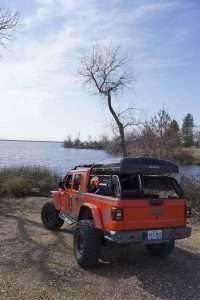
When you change your tire size, it’s important to adjust the lift and gear ratios accordingly.
Larger tires cover more ground per revolution, requiring more force to turn… the solution is to modify the gear ratios to match the new tire size.
Think of it as adjusting a bicycle’s gears for uphill riding – it requires more pedal revolutions but makes the climb easier. Every rig has a different threshold for when gear upgrades are optimal for your rig’s performance.
For instance, it is well known that the Jeep JK Wrangler 2007 – 2011 model years needed a gear change as soon as you moved to 37’s. 35’s it could handle… put on 37’s, and the engine and transmission couldn’t handle it.
However, starting in 2012, with the advent of the new Pentastar V6 in the JK Wrangler, 37’s became the easy upgrade with no gearing modification required. Yes, you could still improve performance with a gear upgrade, but it wasn’t required.
To Armor Up, or Not

Choosing whether or not to run aftermarket fenders, bumpers, rockers, and skid plates can be influenced by a number of personal decisions, including your personal style and destination.
Let’s break these down into two different categories… Skid Plates on the one hand and Fenders & Bumpers on the other… or Necessary vs Unnecessary.
First, we will look at the Necessary, the Skid Plates & Rockers.
Most modern rigs, like the Bronco 6G or the Jeep JT Gladiator, require skids if you are planning any sort of backcountry off-roading. Their stock parts are just too thin and vulnerable.
Besides, there is nothing better than the peace of mind knowing that some random boulder isn’t going to punch a hole in your transfer case.
And don’t forget the rocker protection… stock rock protection is fine, but will only last you a couple of trips on the Rubicon.
Then there’s Unnecessary… fenders, bumpers, and tire carriers.
Front Bumpers

One could easily argue the merits of why you absolutely need an aftermarket tire carrier or fenders, but the truth is that most of us could wheel all over the place without them.
For instance, stock bumpers may be ugly and not as cool as many of the aftermarket styles, nor as strong, but they will do you just fine in most terrains.
Except our old friend, the Rubicon. It will eat that stock bumper alive.
There are far more aftermarket choices for bumpers than any other component on your rig. When choosing your bumper, think recovery points and clearance. Some bumpers are hideously large and just get in the way. Others were built for looks and have recovery points too weak to depend on at that critical moment.
You will also want to consider the winch mounting location. A winch, of course, is a critical recovery tool that most off-roaders should have on their rig, and most aftermarket bumpers are designed to accommodate one. There is a difference, however, in how they mount.
Check to see how high the winch sits… the higher it sits, the more it blocks airflow to the radiator… and on newer rigs, it could actually block the forward-facing camera.
Rear Bumpers & Tire Carriers
When it comes to rear bumpers, the critical component to consider is whether or not you want a tire carrier.

If you are running larger tires, an aftermarket tire carrier is preferred over stock. However, if you are only increasing the tire size by a couple of inches over stock, the tire carrier your rig came with should work just fine.
It has become increasingly popular to eliminate spare tires… something I am personally not a fan of. Doing so completely changes the dynamics of your rig, including the center of gravity and how it performs on and off-road.
The center of gravity is a measurement of where all the masses of a vehicle theoretically react. In the case of the Jeep, the lower the center of gravity (CG), the less chance it has to roll over when rock-crawling or riding some off-camber trail.
It is also important to consider your journey when deciding about a tire carrier… modern tires are great, but they can still get flats in the most inconvenient locations.
Fender Up

Next is aftermarket fenders… yes or no… in most cases, this is a matter of personal choice and style.
At Metalcloak, we designed fenders to be functional… strong enough to fight back mother nature on the trail and high enough to maximize clearance for bigger tires, while still giving that street legalistic coverage.
You can also go full delete and remove the fenders completely if your part of the country doesn’t require tire coverage.
On my personal JT, I use our Gutz Delete kit, which allows for “cut” stock fenders to remain on my rig, but gets rid of the massive lights on the stock fenders and adds more clearance for those larger meats.
The Rule Of Thumb

Your rig is a system… a well-engineered piece of machinery where every part is designed to work together with every other part.
The moment you make a change to one part, you affect the system.
Don’t want to run a spare tire? Fine, but you will affect the center of gravity of your rig and its on and off-road performance.
Adding bigger tires? Good, but you are going to affect the steering system and the axles.
Going for a bigger lift? Nice, but make sure you are using a fully integrated Suspension System, not just a few components for a simple lift kit.
Your rig will thank you.